How Global Tech Conferences Reach Multilingual Audiences.
05 October, 2026· Article by Maria Jones


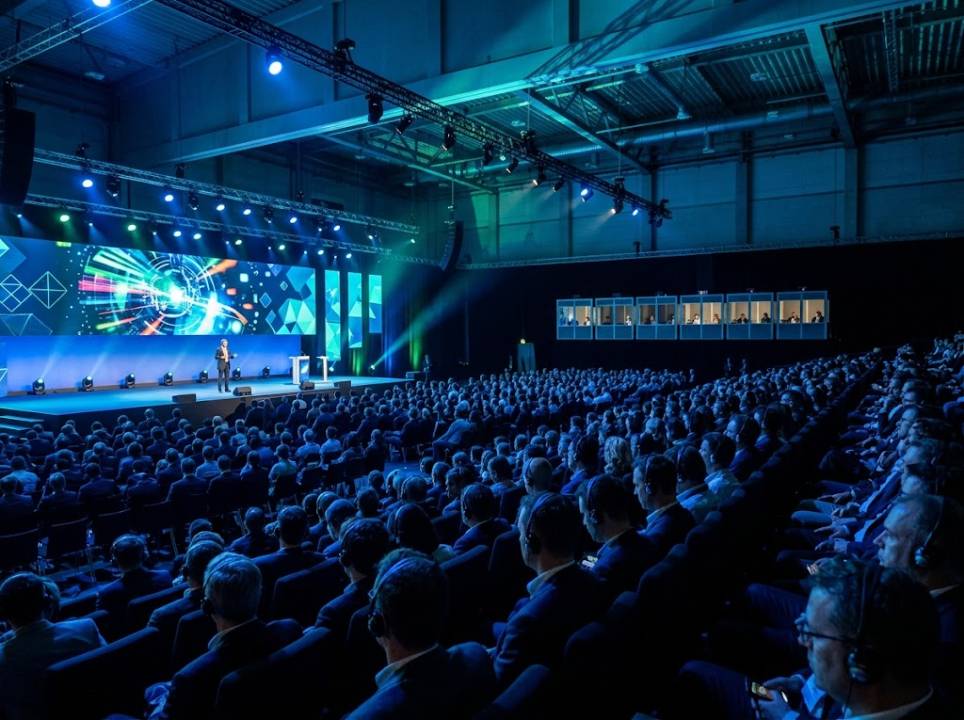
A tech conference used to be a fairly simple thing. A few thousand engineers gathered in a hotel ballroom, everyone spoke English, and the slides were the same for all. Today, events such as Web Summit in Lisbon, VivaTech in Paris or GITEX in Dubai draw visitors from more than a hundred countries. Many of them follow sessions in a second or third language.
Organisers have noticed. Language access has quietly become one of the factors that decides whether an event feels global or merely international.
Why language now matters more
Three trends are pushing conferences to rethink how they handle language. First, attendance from Asia, Latin America and Africa keeps growing. Second, hybrid formats mean many sessions are streamed to audiences who never set foot in the venue. Third, sponsors want their message to land in specific markets, not just in a generic English version.
The result is a mix of solutions that range from human interpreters in booths to AI-generated subtitles and fully localised event apps.
Live interpretation is still the gold standard
For keynotes and high-stakes panels, simultaneous interpretation by trained professionals remains the most reliable option. Interpreters work in pairs in soundproof booths, switching every 20 to 30 minutes, and audiences listen through headsets or a mobile app. The International Association of Conference Interpreters publishes standards on booth setup, team size and working hours that many large organisers follow.
Interpretation is expensive, so most events reserve it for the main stage and a handful of languages. The choice usually reflects the host country and the largest visitor groups. A Berlin event might offer English and German, while a Dubai event leans on English and Arabic.
AI captions fill the gaps
Smaller stages increasingly rely on automatic speech recognition and machine translation. Captions appear on screens next to the speaker or inside the event app, often in several languages at once. Quality has improved sharply since 2023, but it still struggles with accents, product names and technical jargon.
Organisers who get the best results feed the system with glossaries before the event, so that terms like a company's product names or common acronyms are recognised correctly.
Behind the scenes, content is a translation project
What visitors rarely see is the volume of written content around a conference. Agendas, speaker bios, push notifications, sponsor pages, signage, emails and post-event reports can easily run to hundreds of thousands of words across languages.
Larger organisers now manage this the way software companies manage product localisation. A translation management system collects all strings in one place, routes them to translators and reviewers, and pushes approved versions back to the website and app. That makes it possible to update a session time once and see the change appear in every language.
Translators themselves typically work in a CAT tool, which stores previous translations and suggests consistent wording. For an annual event, this matters a lot: last year's descriptions of tracks, venues and ticket types can be reused, cutting both cost and turnaround time.
Germany as a test case
Germany hosts a dense calendar of technology events, from IFA in Berlin to Hannover Messe and a long list of developer and start-up conferences in Munich, Hamburg and Cologne. Many of these events attract a large domestic audience that prefers German, alongside international visitors who expect English.
Exhibitors often underestimate how much this shapes the experience. A booth with English-only materials can feel distant to a German procurement manager, while German-only brochures lose foreign visitors. Companies preparing for these events often use professional german translation services for press releases, product sheets and demo scripts, keeping the technical vocabulary precise in both languages.
What attendees can do
Language support is not only the organiser's job. Attendees can make a big difference to their own experience:
- Download the event app early and check which sessions offer interpretation or captions.
- Bring headphones that work with your phone in case the app streams audio.
- Prepare a short introduction about yourself in the host country's language.
- Ask speakers for slides after the session, then run them through a proper translation if needed.
What exhibitors should plan
For companies with a booth, preparation starts months ahead. Translating product sheets, landing pages and follow-up emails before the event avoids the rush that typically happens the week before. Booking an interpreter for key meetings with partners can also turn a polite conversation into a signed deal.
Exhibitors facing a tight pre-event timeline need speed without sacrificing precision. Many turn to translation services that specialise in fast delivery, where experienced linguists and translation memory combine to turn around product sheets and demo scripts in days rather than weeks. The same workflow that reuses last year's terminology also keeps the technical vocabulary consistent across every brochure and landing page. For a booth competing for attention, that mix of pace and accuracy can be the difference between a polite chat and a signed deal.
It is also worth thinking about follow-up. Leads gathered at a multilingual event deserve emails in their own language. Templates translated in advance save a lot of time when the inbox fills up after the show.
Where this is heading
Expect more events to offer real-time translation inside their apps, more personalised agendas in each attendee's preferred language and more hybrid human and machine workflows behind the scenes. Human interpreters are unlikely to disappear from main stages, where accuracy and nuance matter most, but they will increasingly share the work with AI tools.
For organisers, the lesson is simple. A conference only feels global when people from many countries can follow, ask questions and do business in a language they are comfortable with.
A tech conference used to be a fairly simple thing. A few thousand engineers gathered in a hotel ballroom, everyone spoke English, and the slides were the same for all. Today, events such as Web Summit in Lisbon, VivaTech in Paris or GITEX in Dubai draw visitors from more than a hundred countries. Many of them follow sessions in a second or third language.
A tech conference used to be a fairly simple thing. A few thousand engineers gathered in a hotel ballroom, everyone spoke English, and the slides were the same for all. Today, events such as Web Summit in Lisbon, VivaTech in Paris or GITEX in Dubai draw visitors from more than a hundred countries. Many of them follow sessions in a second or third language.
Organisers have noticed. Language access has quietly become one of the factors that decides whether an event feels global or merely international.
Why language now matters more
Three trends are pushing conferences to rethink how they handle language. First, attendance from Asia, Latin America and Africa keeps growing. Second, hybrid formats mean many sessions are streamed to audiences who never set foot in the venue. Third, sponsors want their message to land in specific markets, not just in a generic English version.
Three trends are pushing conferences to rethink how they handle language. First, attendance from Asia, Latin America and Africa keeps growing. Second, hybrid formats mean many sessions are streamed to audiences who never set foot in the venue. Third, sponsors want their message to land in specific markets, not just in a generic English version.
The result is a mix of solutions that range from human interpreters in booths to AI-generated subtitles and fully localised event apps.
Live interpretation is still the gold standard
For keynotes and high-stakes panels, simultaneous interpretation by trained professionals remains the most reliable option. Interpreters work in pairs in soundproof booths, switching every 20 to 30 minutes, and audiences listen through headsets or a mobile app. The International Association of Conference Interpreters publishes standards on booth setup, team size and working hours that many large organisers follow.
For keynotes and high-stakes panels, simultaneous interpretation by trained professionals remains the most reliable option. Interpreters work in pairs in soundproof booths, switching every 20 to 30 minutes, and audiences listen through headsets or a mobile app. The International Association of Conference Interpreters publishes standards on booth setup, team size and working hours that many large organisers follow.
Interpretation is expensive, so most events reserve it for the main stage and a handful of languages. The choice usually reflects the host country and the largest visitor groups. A Berlin event might offer English and German, while a Dubai event leans on English and Arabic.
Interpretation is expensive, so most events reserve it for the main stage and a handful of languages. The choice usually reflects the host country and the largest visitor groups. A Berlin event might offer English and German, while a Dubai event leans on English and Arabic.
AI captions fill the gaps
Smaller stages increasingly rely on automatic speech recognition and machine translation. Captions appear on screens next to the speaker or inside the event app, often in several languages at once. Quality has improved sharply since 2023, but it still struggles with accents, product names and technical jargon.
Smaller stages increasingly rely on automatic speech recognition and machine translation. Captions appear on screens next to the speaker or inside the event app, often in several languages at once. Quality has improved sharply since 2023, but it still struggles with accents, product names and technical jargon.
Organisers who get the best results feed the system with glossaries before the event, so that terms like a company's product names or common acronyms are recognised correctly.
Organisers who get the best results feed the system with glossaries before the event, so that terms like a company's product names or common acronyms are recognised correctly.
Behind the scenes, content is a translation project
What visitors rarely see is the volume of written content around a conference. Agendas, speaker bios, push notifications, sponsor pages, signage, emails and post-event reports can easily run to hundreds of thousands of words across languages.
What visitors rarely see is the volume of written content around a conference. Agendas, speaker bios, push notifications, sponsor pages, signage, emails and post-event reports can easily run to hundreds of thousands of words across languages.
Larger organisers now manage this the way software companies manage product localisation. A translation management system collects all strings in one place, routes them to translators and reviewers, and pushes approved versions back to the website and app. That makes it possible to update a session time once and see the change appear in every language.
Larger organisers now manage this the way software companies manage product localisation. A translation management system collects all strings in one place, routes them to translators and reviewers, and pushes approved versions back to the website and app. That makes it possible to update a session time once and see the change appear in every language.
Translators themselves typically work in a CAT tool, which stores previous translations and suggests consistent wording. For an annual event, this matters a lot: last year's descriptions of tracks, venues and ticket types can be reused, cutting both cost and turnaround time.
Translators themselves typically work in a CAT tool, which stores previous translations and suggests consistent wording. For an annual event, this matters a lot: last year's descriptions of tracks, venues and ticket types can be reused, cutting both cost and turnaround time.
Germany as a test case
Germany hosts a dense calendar of technology events, from IFA in Berlin to Hannover Messe and a long list of developer and start-up conferences in Munich, Hamburg and Cologne. Many of these events attract a large domestic audience that prefers German, alongside international visitors who expect English.
Germany hosts a dense calendar of technology events, from IFA in Berlin to Hannover Messe and a long list of developer and start-up conferences in Munich, Hamburg and Cologne. Many of these events attract a large domestic audience that prefers German, alongside international visitors who expect English.
Exhibitors often underestimate how much this shapes the experience. A booth with English-only materials can feel distant to a German procurement manager, while German-only brochures lose foreign visitors. Companies preparing for these events often use professional german translation services for press releases, product sheets and demo scripts, keeping the technical vocabulary precise in both languages.
Exhibitors often underestimate how much this shapes the experience. A booth with English-only materials can feel distant to a German procurement manager, while German-only brochures lose foreign visitors. Companies preparing for these events often use professional german translation services for press releases, product sheets and demo scripts, keeping the technical vocabulary precise in both languages.
What attendees can do
Language support is not only the organiser's job. Attendees can make a big difference to their own experience:
- Download the event app early and check which sessions offer interpretation or captions.
- Bring headphones that work with your phone in case the app streams audio.
- Prepare a short introduction about yourself in the host country's language.
- Ask speakers for slides after the session, then run them through a proper translation if needed.
What exhibitors should plan
For companies with a booth, preparation starts months ahead. Translating product sheets, landing pages and follow-up emails before the event avoids the rush that typically happens the week before. Booking an interpreter for key meetings with partners can also turn a polite conversation into a signed deal.
For companies with a booth, preparation starts months ahead. Translating product sheets, landing pages and follow-up emails before the event avoids the rush that typically happens the week before. Booking an interpreter for key meetings with partners can also turn a polite conversation into a signed deal.
It is also worth thinking about follow-up. Leads gathered at a multilingual event deserve emails in their own language. Templates translated in advance save a lot of time when the inbox fills up after the show.
It is also worth thinking about follow-up. Leads gathered at a multilingual event deserve emails in their own language. Templates translated in advance save a lot of time when the inbox fills up after the show.
Where this is heading
Expect more events to offer real-time translation inside their apps, more personalised agendas in each attendee's preferred language and more hybrid human and machine workflows behind the scenes. Human interpreters are unlikely to disappear from main stages, where accuracy and nuance matter most, but they will increasingly share the work with AI tools.
Expect more events to offer real-time translation inside their apps, more personalised agendas in each attendee's preferred language and more hybrid human and machine workflows behind the scenes. Human interpreters are unlikely to disappear from main stages, where accuracy and nuance matter most, but they will increasingly share the work with AI tools.
For organisers, the lesson is simple. A conference only feels global when people from many countries can follow, ask questions and do business in a language they are comfortable with.
For organisers, the lesson is simple. A conference only feels global when people from many countries can follow, ask questions and do business in a language they are comfortable with.
Recent Posts
Tech-Konferenzen im Ausland er...
Exposer à VivaTech et dans le...
How to Make a Tech Networking ...

Why the Most Important Tech Co...

Gli Eventi Tech Che Decidono i...

Là Où la Tech Réécrit Notr...
Share it.

Links
We use cookies
We use cookies to give you the best online experience, remember your preferences, and understand how the site is used. You can accept all cookies, reject optional ones, or choose which categories to allow.
Privacy PolicyCookie preferences
Choose which cookies we can use. Necessary cookies stay on because the site cannot work without them.
For more details, read our Privacy Policy.